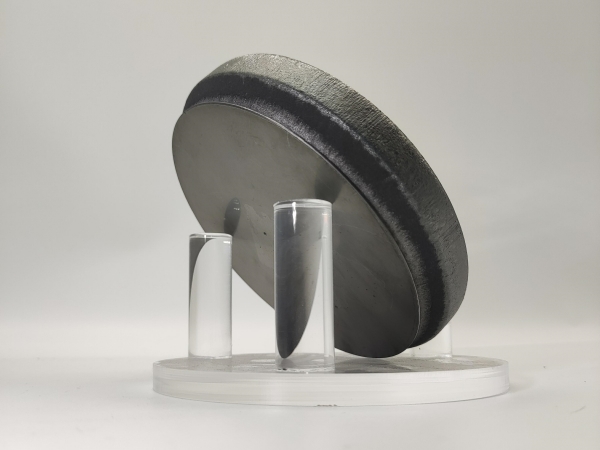
As a critical third-generation semiconductor material, silicon carbide (SiC) features outstanding high-temperature stability, high breakdown electric field, and excellent carrier mobility. Among its multiple polytypes, cubic 3C-SiC possesses unique advantages including lower interface state density and superior electron transport capability, making it highly promising for low-voltage power devices, radio-frequency electronics, and next-generation integrated circuits. Nevertheless, the controlled growth of high-quality and large-diameter 3C-SiC single crystals remains a major challenge. The inherent polytype competition between 3C-SiC and 4H-SiC severely restricts phase stability, resulting in high defect density and limited wafer size in conventional growth processes.
To address these bottlenecks, this work adopts the top-seeded solution growth (TSSG) technique to realize the selective and stable growth of 3C-SiC single crystals. By precisely tuning the melt–solid interfacial energy, we successfully prioritize 3C-SiC nucleation while suppressing the undesired 4H-SiC polytype growth. Using this optimized strategy, bulk 3C-SiC single crystals with a maximum diameter of 4 inches and a thickness over 4.0 mm are successfully fabricated, demonstrating great potential for industrial-scale production.
Fundamental Design of the TSSG Growth Strategy
Compared with the conventional physical vapor transport (PVT) method, TSSG exhibits unique superiority in regulating polytype selection. In typical PVT growth, only a gas–solid interface exists during crystal growth, leaving limited room for interfacial energy modulation. In contrast, the TSSG method introduces a liquid melt phase whose chemical composition can be flexibly adjusted to effectively regulate the interfacial energy between SiC and the melt. Liquid phases are theoretically more effective in modulating interfacial energy than gaseous phases, providing a reliable way to break the inherent growth advantage of 4H-SiC.
The core principle of our strategy is to reduce the interfacial energy of 3C-SiC to a sufficiently lower level than that of 4H-SiC. Under such thermodynamic conditions, the nucleation and subsequent growth of 3C-SiC become energetically favorable, whereas the nucleation of 4H-SiC is effectively suppressed. In addition, the TSSG technique has been verified to grow high-quality 4-inch-class 4H-SiC single crystals at 1700–1800 °C, confirming its feasibility for large-size SiC crystal growth. Based on this mature technical framework, we further optimize the growth parameters to achieve stable 3C-SiC bulk crystal growth.
TSSG Growth System and Crystal Growth Mechanism
In this study, high-purity graphite crucibles are used as both containers and carbon sources for crystal growth. A stable temperature gradient of 5–15 °C cm⁻¹ is constructed via induction heating, with the top melt temperature maintained at approximately 1850 °C. The melt system consists of Cr, Ce, and Si, which forms a homogeneous liquid phase above 1680 °C. The composite flux exhibits temperature- and composition-dependent carbon solubility, providing stable carbon supply for SiC crystallization.
The entire TSSG growth process can be divided into three continuous and coordinated stages. First, the high-temperature region of the graphite crucible dissolves into the flux, introducing 10–15 at.% carbon atoms into the liquid phase. Second, thermal convection drives the continuous transport of dissolved carbon atoms from the high-temperature bottom region to the low-temperature upper region. Third, carbon atoms recombine with silicon atoms and crystallize on the seed surface to form SiC single crystals under a slight temperature drop. Stable SiC growth requires dynamic equilibrium of carbon transportation throughout the three stages. Commercial semi-insulating 4H-SiC (0001) wafers are adopted as seed crystals, and the growth is carried out under a mixed Ar/N₂ atmosphere.
 Figure 1. TSSG growth of 3C-SiC single crystals.
 a)Schematic of the setup for growing 3C-SiC by TSSG.
b) Schematic of three basic growth processes for
TSSG: 1) Dissolving C from the graphite crucible at high-temperature region; 2) Transportation of C from the high-temperature region to the low
temperature driven by the convection; and 3) Crystallization of SiC on the low-temperature seed crystal.
Thermodynamic Analysis of Selective 3C-SiC Heterogeneous Nucleation
To clarify the physical mechanism of preferential 3C-SiC growth, we analyze the Gibbs free energy variation of 2D nucleation on vicinal 4H-SiC (0001) surfaces. The homogeneous nucleation Gibbs free energy of 4H-SiC and the heterogeneous nucleation Gibbs free energy of 3C-SiC are calculated and compared. Two reasonable physical assumptions are proposed for simplification: the lateral interfacial energies of 4H-SiC and 3C-SiC are approximately equal due to their similar atomic stacking modes at the macro scale; the interfacial energy between 4H-SiC and 3C-SiC is nearly zero because of their negligible lattice mismatch.
Under these premises, when the interfacial energy difference between 3C-SiC/melt and 4H-SiC/melt becomes negative, the heterogeneous nucleation barrier of 3C-SiC is always lower than the homogeneous nucleation barrier of 4H-SiC. This indicates that 3C-SiC nucleates more easily on the
4H-SiC seed surface and possesses a faster step-flow growth rate, eventually fully covering the substrate and realizing stable single-phase growth.

c) Proposed growth model of 3C-SiC on a 4H-SiC
seed via TSSG.
The schematic diagram illustrates the complete phase transition pathway from preferential heterogeneous nucleation to continuous 3C-SiC growth. Experimental results verify that when the nitrogen partial pressure exceeds 15 kPa, the 3C-SiC/melt interfacial energy is significantly reduced, which provides sufficient thermodynamic driving force for stable 3C-SiC growth and eliminates 4H-SiC polytype interference.
Morphology and Basic Performance of Large-Size 3C-SiC Crystals
Under an optimized nitrogen partial pressure of 20 kPa, 2-inch, 3-inch, and 4-inch bulk 3C-SiC boules are successfully grown. After an 84-hour growth cycle, the crystal thickness ranges from 4.0 mm to 10.0 mm, with a growth rate of 50–113 μm h⁻¹. Although the growth rate is slightly lower than that of the conventional PVT method, the TSSG-grown crystals exhibit superior polytype purity and structural stability. Benefiting from nitrogen doping, the sliced 3C-SiC wafers appear black under ambient light and show a distinct green color under strong light irradiation, which matches the typical optical characteristics of high-quality 3C-SiC.
 Figure 1. TSSG growth of 3C-SiC single crystals.
 d–f) Photographs of 2-, 3-inch 3C-SiC boule after rounded cutting process and as-grown 4-inch 3C-SiC boule. The thickness of the 2–4-inch
3C-SiC boule is above 4.0 mm.
g) Photograph of 3C-SiC single crystal wafer.
Structural Identification and Phase Purity Verification
Raman scattering tests are performed at 20 uniformly distributed positions on the wafer surface. All Raman spectra show a consistent characteristic transverse optical (TO) peak at 796 cm⁻¹, which is the typical signature of single-phase 3C-SiC. No characteristic peaks of 4H-SiC or
6H-SiC are observed, confirming high polytype purity. The undetected longitudinal optical (LO) peak at 975 cm⁻¹ further indicates uniform and stable crystal quality. A weak peak at 741 cm⁻¹ originates from minor stacking faults and residual stress. Cross-sectional Raman tests reveal that only a narrow 20 μm transition zone contains mixed 4H/3C phases near the seed layer, while the entire upper crystal region maintains pure 3C-SiC phase. The photoluminescence (PL) peak at 523 nm corresponds to a bandgap of 2.36 eV, further confirming the successful synthesis of high-purity 3C-SiC.
 Figure 2. Identification and confirmation of 3C-SiC polytype for as-grown crystals.
 a) Raman spectra of 3C-SiC measured on 20 points on the 2-inch crystal. The inset shows the distribution of all measured points.
b)Raman spectra of seed 4H-SiC, TZ (transition zone) and as-grown 3C-SiC.
High-resolution HAADF-STEM characterization clearly presents the standard ABC atomic stacking sequence of 3C-SiC. The selected area electron diffraction (SAED) pattern matches the F-43m space group perfectly, proving the intact cubic crystal structure. EELS and EDS mapping results confirm the uniform distribution of Si, C, and doped N elements at the nanoscale, without elemental segregation or abnormal phase aggregation.
 Figure 2. Identification and confirmation of 3C-SiC polytype for as-grown crystals.
 c) PL spectrum of 3C-SiC measured at 300 K.
d) Plan-view high-angle annular dark field scanning TEM
(HAADF-STEM) image of 3C-SiC. Si and C atoms are superimposed. Inset is SAED measured along ½ _x0005_ 110 Z.A. (zone axis).
Crystallinity and Defect Characterization
XRD θ-2θ scanning results only display (111) and (222) diffraction peaks, indicating that the 3C-SiC crystal grows preferentially along the (111) crystal plane. The X-ray rocking curve (XRC) test shows that the full width at half maximum (FWHM) of the (111) plane ranges from 28.8 to 32.4 arcsec, with an average value of 30.0 arcsec. The ultra-uniform FWHM distribution across the entire wafer represents one of the best crystallinity levels for large-size (≥2-inch) 3C-SiC wafers reported so far.
 Figure 3. Characterizing the crystallinity and defects of 3C-SiC wafer.
 a) X-ray diffraction (XRD) spectrum for 3C-SiC wafer, showing the growing surface is (111) plane.
b) X-ray rocking curve (XRC) of (111) plane, and the FWHM ranges from 28.8 to 32.4 arcsec. The inset shows the distribution of 9 measured points.
After molten KOH etching, surface defects are systematically observed via OM and SEM. Typical surface features include linear stacking fault ridges, triangular pits induced by threading screw dislocations (TSDs), and rounded-triangular pits derived from threading edge dislocations (TEDs). The average stacking fault density is as low as 92.2 cm⁻¹, which is significantly lower than previously reported values. TEM results confirm that the stacking faults only consist of three layers of (111) atomic planes with tiny structural scale. The densities of TSDs and TEDs are calculated to be 4.3 × 10⁴ cm⁻² and 13.9 × 10⁴ cm⁻², respectively. Notably, no double-positioning boundaries (DPBs), a common harmful defect in conventional 3C-SiC, are found in our TSSG-grown crystals, demonstrating excellent structural integrity.
 Figure 3. Characterizing the crystallinity and defects of 3C-SiC wafer.
 c–f) OM (Optical microscope) images for 3C-SiC wafer after etch at 500 °C for 10 min in KOH melt, revealing the existence of stacking fault (SF), threading screw dislocations (TSDs), and threading edge dislocations (TEDs) defects in the 3C-SiC wafers.
g, h) HAADF-STEM images of a SF composed of three layers of SiC.
Electrical Properties of N-Doped 3C-SiC Single Crystals
The electrical performance of the as-grown 3C-SiC crystals is measured by a standard six-wire method. The samples grown under 15–20 kPa N₂ partial pressure exhibit typical metallic conduction behavior. The room-temperature resistivity is only 0.58 mΩ·cm, which is far lower than that of commercial 4H-SiC (15–28 mΩ·cm). The carrier concentration reaches 1.89 × 10²⁰ cm⁻³, which is highly consistent with the SIMS-tested nitrogen doping concentration, indicating nearly 100% dopant activation at room temperature.
By adjusting the nitrogen partial pressure to reduce carrier density, the carrier mobility can be improved to 66.24 cm² (V·s)⁻¹, while the resistivity remains much lower than traditional 3C-SiC materials. In contrast, crystals grown under 10 kPa N₂ show semiconductor characteristics below 100 K, realizing flexible modulation of electrical properties via atmosphere regulation. The excellent electrical performance endows the TSSG-grown 3C-SiC with great application potential for high-efficiency power devices.
Conclusion
In this work, we systematically demonstrate a reliable TSSG growth strategy for stabilizing large-size 3C-SiC single crystals. By modulating the melt–solid interfacial energy and optimizing nitrogen partial pressure, we effectively suppress 4H-SiC polytype competition and realize preferential 3C-SiC nucleation and growth. High-quality 2–4 inch bulk 3C-SiC single crystals with ultra-low defect density, excellent crystallinity, and superior electrical conductivity are successfully prepared. This study proves that the TSSG technique is a promising approach for the low-cost, large-scale, and high-quality fabrication of 3C-SiC single crystals, laying a solid foundation for the industrial application of next-generation SiC-based semiconductor devices.