Polytype competition has long been the core bottleneck restricting the stable growth of high-quality 3C-SiC single crystals. Unlike the fixed gas-solid interface of the conventional PVT growth method, the top-seeded solution growth (TSSG) technique features tunable liquid-solid interfacial properties, which provides a unique pathway to break the dominant growth advantage of 4H-SiC. Previous thermodynamic deductions have verified that lowering the 3C-SiC/melt interfacial energy is the key to realizing preferential nucleation and stable growth of single-phase 3C-SiC. To fully confirm this core mechanism, we conduct systematic high-temperature interfacial characteristic tests, quantitatively analyze the modulation law of nitrogen partial pressure on melt surface tension and solid-liquid interfacial energy, and clarify the intrinsic correlation between interfacial energy difference and 3C-SiC polytype stability.
High-Temperature Interfacial Characteristic Experimental System
All interfacial property measurements are carried out at a constant growth temperature of 1850 °C, consistent with the actual TSSG crystal growth temperature, and the total reaction chamber pressure is fixed at 50 kPa. A series of gradient nitrogen partial pressures (0 kPa, 10 kPa, 15 kPa, 20 kPa) are set to explore the atmospheric modulation effect. The Cr-Ce-Si ternary composite flux used in the test is completely consistent with the crystal growth formula, ensuring the authenticity and applicability of experimental data. High-temperature sessile drop method and intravenous drip method are adopted to accurately measure the contact angle and surface tension of the melt on different SiC polytype substrates, respectively.
Macroscopic Wetting Behavior and Interfacial Parameter Measurement
The image shows the equilibrium morphology of the optimized Cr-Ce-Si melt droplet on the 3C-SiC (111) crystal surface under a nitrogen partial pressure of 20 kPa. The statistical equilibrium contact angle is 40.38° ± 0.64°, presenting excellent wetting performance between the liquid flux and cubic SiC crystal plane.

Figure 4. In situ measurements of contact angles and surface tension of melts. High-temperature
contact angle of melt droplet of Melt 4 on
- 3C-SiC (111) surface
Under the identical temperature and atmospheric conditions, the melt droplet on the semi-insulating 4H-SiC (0001) basal plane exhibits a significantly larger contact angle of 45.55° ± 0.07°. The distinct contact angle difference intuitively proves that the Cr-Ce-Si melt has a stronger interfacial affinity for 3C-SiC than 4H-SiC, which is the macroscopic manifestation of lower 3C-SiC/melt interfacial energy.

b)semi-insulated
4H-SiC (0001) surface. The average contact angles are 40.38° 0.64° and 45.55° 0.07°, respectively.
The intravenous drip method is utilized to test the surface tension of the optimized melt (Melt 4) at 1850 °C. The test results show that the melt surface tension is 761.24 ± 27.83 mN·m⁻¹. Repeated verification experiments (Figure S14, Figure S15 in Supporting Information) confirm that the measured data has high stability and repeatability, providing accurate basic parameters for subsequent interfacial energy calculation.

- Measurement of surface tension of Melt 4 via intravenous drip method.
Quantitative Calculation of Solid-Liquid Interfacial Energy
Based on the classic Young’s wetting equilibrium equation, the solid-liquid interfacial energy of different SiC polytypes and molten flux is quantitatively calculated:
σSiC/Melt =σ SiC - σSiC - σMeltCOSθIn this formula,
σSiC represents the intrinsic surface energy of SiC crystal (referenced from published authoritative research data),
σMelt is the measured melt surface tension, and

is the equilibrium contact angle between melt and SiC substrate.
Combined with the measured contact angle and surface tension data under 20 kPa nitrogen partial pressure, the final interfacial energy values are obtained: the interfacial energy of 3C-SiC/melt is 2151.11 ± 21.90 mN·m⁻¹, while that of 4H-SiC/melt reaches 2390.89 ± 19.50 mN·m⁻¹. The negative interfacial energy difference
(\sigma_\mathrm{3C/Melt}-\sigma_\mathrm{4H/Melt} < 0) directly validates the thermodynamic principle of preferential 3C-SiC nucleation, perfectly supporting the previous theoretical nucleation model.
Modulation Law of Nitrogen Partial Pressure on Interfacial Properties
The multi-dimensional statistical histogram systematically presents the variation law of melt surface tension, substrate contact angle and solid-liquid interfacial energy difference with nitrogen partial pressure (0–20 kPa). With the increase of nitrogen partial pressure, the surface tension of Cr-Ce-Si melt decreases monotonically. This phenomenon is attributed to the dissolution of nitrogen atoms in the melt, which acts as a surface active substance to reduce the intermolecular cohesion of the liquid phase (Figure S16 in Supporting Information).

d) Histogram of surface
tension (upper panel), high-temperature contact angles on 3C-SiC (111) and 4H-SiC (0001) planes
(lower panel), the solid–liquid interfacial energy difference between melt and 4H-SiC (0001) and 3C
SiC (111) surface (middle panel) of Melt 4. The measurements are carried out at 1850 °C under pN2
of 0 (Melt 1), 10 (Melt 2), 15 (Melt 3), and 20 kPa (Melt 4) with the total growth pressure of
50 kPa.
Meanwhile, the interfacial energy gap between 4H-SiC and 3C-SiC is gradually widened with the elevation of nitrogen pressure. A critical threshold of 15 kPa nitrogen partial pressure is confirmed in the experiment: when
pN2<15kPa, the interfacial energy difference is insufficient to completely offset the nucleation advantage of 4H-SiC, resulting in mixed polytype impurities in the grown crystals; when
pN2≥15kPa , the interfacial energy advantage of 3C-SiC is fully amplified, realizing complete suppression of 4H-SiC polytype competition.
To further verify the stability of the modulation strategy, secondary epitaxial growth is carried out on pure 3C-SiC seed crystals under the optimal 20 kPa nitrogen atmosphere. Raman spectral characterization (Figure S17 in Supporting Information) only detects the characteristic peak of single-phase 3C-SiC, confirming that the atmosphere-regulated interfacial energy control method is stable and reversible.
Full Research Conclusion and Industrial Implications
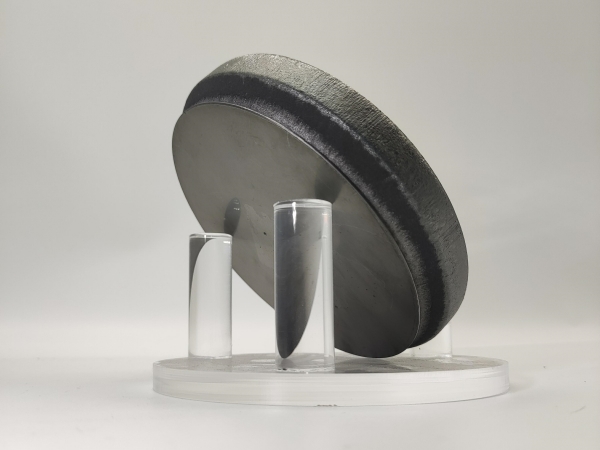
Different from the prediction range of classical nucleation theory, this study proves that the atmospheric modulation of melt interfacial properties can construct a sufficient negative interfacial energy difference between 3C-SiC and 4H-SiC, fundamentally reversing the nucleation priority of the two polytypes and realizing stable growth of large-size 3C-SiC single crystals. The optimized TSSG process successfully prepares 4-inch high-quality 3C-SiC bulk crystals with a controllable thickness of 4.0–10.0 mm. The as-grown crystals integrate ultra-high crystallinity, ultra-low defect density and excellent metallic conductivity, which are ideal substrates for homogeneous epitaxial growth and high-performance power device fabrication.
This work establishes a reliable and scalable interfacial energy modulation strategy for 3C-SiC growth, breaking the technical bottleneck of polytype uncontrollability in traditional growth processes. The TSSG-based growth route realizes low-cost and high-quality preparation of wafer-scale 3C-SiC, which greatly promotes the industrialization process of cubic silicon carbide semiconductor materials. More importantly, the atmosphere-liquid-solid interfacial regulation mechanism proposed in this study is universal, providing a novel technical idea for the growth of other difficult-to-prepare single-phase polytypic layered materials, and expanding the application boundary of solution growth technology in the field of wide-bandgap semiconductors.