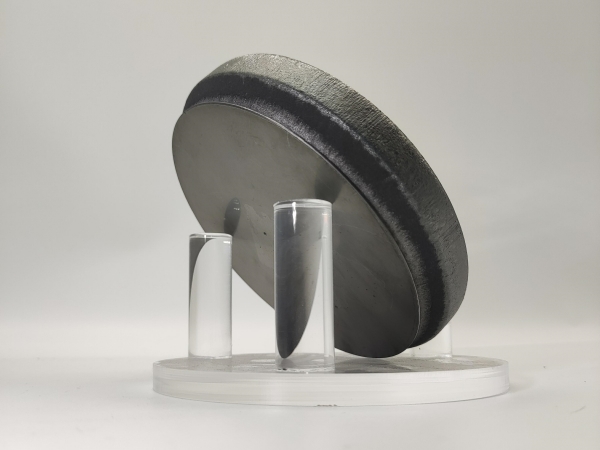
Properties, Manufacturing Differences, and Market Applications
Diamond substrates are broadly classified into
single crystal and
polycrystalline types based on their crystal structure. Both benefit from ultra-high thermal conductivity and extreme hardness, making them important in semiconductors, optics, and precision manufacturing.
However, their fundamentally different crystal arrangements result in significant differences in performance limits, manufacturing complexity, and market positioning. This article provides a structured comparison of their key characteristics and application directions.

1. Core Material Property Differences
Single crystal diamond features a long-range ordered tetrahedral lattice without grain boundaries.
Polycrystalline diamond consists of randomly oriented diamond grains separated by grain boundaries.
These structural differences directly determine their mechanical, thermal, optical, and electrical behavior.
| Property Category |
Single Crystal Diamond Substrate |
Polycrystalline Diamond Substrate |
Root Cause of Difference |
| Mechanical |
Mohs 10; microhardness 7000–10000 kg/mm²; anisotropic hardness; brittle, prone to cleavage |
Mohs 10; microhardness 6500–9000 kg/mm²; isotropic hardness; better toughness and impact resistance |
No grain boundaries in single crystal → stress concentrates along cleavage planes; grain boundaries in polycrystal disperse stress but reduce uniformity |
| Thermal |
1000–2310 W/(m·K); thermal expansion 0.8×10⁻⁶/°C; uniform heat conduction |
800–1500 W/(m·K); slightly higher expansion (0.9–1.1×10⁻⁶/°C); thermal resistance at grain boundaries |
Grain boundary scattering in polycrystal reduces and localizes heat conduction |
| Optical |
225 nm–25 μm transmission; ~71.6% theoretical transmission; no scattering; excellent uniformity |
Similar spectral range but 60–70% transmission; grain boundary scattering; lower optical uniformity |
Grain boundaries cause refraction and scattering losses |
| Electrical |
Bandgap 5.47 eV; breakdown 10 MV/cm; uniform dielectric properties; controllable doping |
Similar bandgap; grain-boundary defect states; poorer doping uniformity; higher parasitic capacitance |
Carrier trapping and defects at grain boundaries affect stability |
| Chemical |
Highly inert; ultra-high purity (Type IIa possible); slightly better oxidation resistance |
Similar inertness; impurities accumulate at grain boundaries; oxidation may initiate at boundaries |
Grain boundary defects act as impurity and reaction sites |
Summary:Single crystal diamond offers higher performance and uniformity. Polycrystalline diamond provides better toughness and cost efficiency but with lower performance ceilings.
2. Manufacturing Differences
Both materials are produced using HPHT (High Pressure High Temperature) and CVD (Chemical Vapor Deposition) technologies, but process control complexity and product positioning differ significantly.
2.1 HPHT Method
Single Crystal Diamond (HPHT):Strict control: 1300–1700°C, 5–7 GPa
Requires crystal seeds and precise orientation control
Long growth cycle (weeks to months)
Max size ~20 mm
Lower nitrogen content possible (<1.2 ppm)
High defect risk in large sizes
Polycrystalline Diamond (HPHT):Broader temperature/pressure tolerance
No strict orientation control required
Faster growth (days to weeks)
Lower cost (1/3–1/2 of single crystal)
Easier large-area production
More grain boundary defects
2.2 CVD (Especially MPCVD)
CVD, particularly Microwave Plasma CVD (MPCVD), is the mainstream industrial route.
Single Crystal CVD:Requires single crystal seed
Precise methane concentration control (6–8%)
Strict suppression of secondary nucleation
Growth rate ~12 μm/h
Surface roughness after CMP: Ra ≤0.5 nm
2-inch wafers in pilot production; 3–4 inch under validation
Yield ~52%
Cost >3× polycrystalline
Polycrystalline CVD:No single crystal seed required
Grows on Si, SiC, or other substrates
Broader methane tolerance (4–10%)
Faster growth (15–20 μm/h)
8-inch production achievable
Surface roughness <1 nm (2-inch level)
Lower cost, but bow and uniformity challenges remain
2.3 Cost & Technical Bottlenecks
Single crystal: Limited by large-diameter, low-defect growth and cost control
Polycrystalline: Limited by grain boundary defects and flatness uniformity
Single crystal pushes performance boundaries; polycrystalline focuses on scalable production.
3. Market Application Segmentation
Performance differences naturally define application positioning.
3.1 Single Crystal Diamond Applications
High-performance, high-value markets.
1. Advanced SemiconductorsGaN-on-diamond RF devices (3× power density vs. SiC)
5G/6G base stations
Aerospace radiation-resistant electronics
High-temperature power devices
2. High-End OpticskW-level laser windows and lenses
Infrared satellite optics
Deep-space detection systems
3. Quantum TechnologiesNV-center quantum sensors
12C enrichment >99.99%
Magnetic sensitivity ~1 pT/√Hz
Applications in neural imaging and precision navigation
Market size is smaller but rapidly growing with strong technical barriers.
3.2 Polycrystalline Diamond Applications
Broader, cost-sensitive markets.
1. General Thermal ManagementHeat spreaders for servers, EV chargers, inverters
Diamond-metal composite substrates
Suitable for medium heat flux applications
2. Precision Machining ToolsCutting tools for carbide, ceramics, composites
Aerospace and automotive components
3–5× longer tool life
3. Industrial & Mid-Range OpticsProtective laser windows
Spectroscopy components
Electrodes for ozone production and wastewater treatment
Polycrystalline diamond dominates high-volume industrial markets.
4. Competitive Landscape & Trends
Market Structure
Single crystal market: Concentrated among high-tech leaders such as Element Six and Orbray. High-end segments remain technology-driven.
Polycrystalline market: More competitive; strong cost advantages enable large-scale production, especially in China.
Development Trends
Single Crystal:Moving toward 4–6 inch wafers
Lower defect density
Cost reduction through localized MPCVD equipment
Higher penetration in quantum and RF electronics
Polycrystalline:Grain refinement and flatness optimization
Expansion into mid-to-high-end thermal management
Leveraging large-area production advantages
5. Conclusion
Single crystal and polycrystalline diamond substrates represent two complementary development paths:
Single crystal: Performance-driven, targeting high-end semiconductors, quantum devices, and advanced optics. The key challenge is large-diameter, low-cost production.
Polycrystalline: Cost- and scale-driven, widely used in precision machining and mid-range thermal management. Performance enhancement and uniformity control are the main upgrade directions.
As manufacturing technology matures and costs decline, both types will continue to coexist and expand their presence across high-performance and large-scale industrial applications, jointly accelerating the adoption of diamond materials in advanced manufacturing.