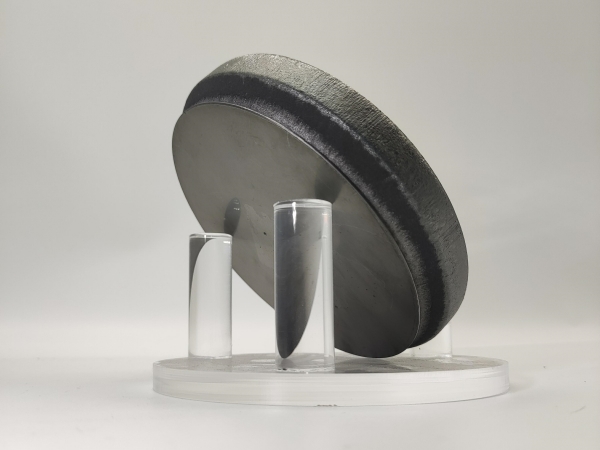
Diamond substrates, with ultra-high thermal conductivity (up to 2000 W/(m·K)), excellent chemical inertness, and a wide bandgap, are ideal heat-spreading materials for heterogeneous integration of wide bandgap semiconductors such as GaN and SiC. Wafer bonding is the key integration pathway between diamond and semiconductor devices.
Surface quality — particularly flatness (TTV, Warp) and roughness (Ra) — directly determines bonding yield, interface strength, thermal resistance, and electrical stability. This article systematically analyzes how surface finishing processes of single crystal, polycrystalline diamond, and diamond films affect wafer bonding performance.
1. Key Surface Quality Metrics and Process Control Ranges
Wafer bonding requires extremely high surface quality. Core evaluation indicators include:
Roughness (Ra)Total Thickness Variation (TTV)Warp (bow/curvature)Due to structural differences, surface processing difficulty and achievable specifications vary significantly among diamond types.
| Diamond Type |
Typical Surface Process |
Roughness
(Ra) |
Flatness
(TTV / Warp) |
Main Technical Challenge |
| Single Crystal Diamond |
Laser trimming + mechanical machining + CMP |
Mass production: Ra <1 nm; Custom: ≤0.5 nm |
TTV ≤10 μm; Warp ≤10 μm (2-inch) |
Extreme hardness → low CMP efficiency; must balance removal rate and surface damage |
| Polycrystalline Diamond |
Dynamic Plasma Polishing (DPP) + chemical polishing |
1–2”: Ra <1 nm (down to <0.5 nm); 3–4”: Ra <2 nm |
2”: Warp ≤10 μm; larger sizes more challenging |
Grain boundaries and stress non-uniformity cause pits and protrusions |
| Diamond Thin Film |
MPCVD deposition + plasma-assisted polishing |
High quality: Ra ≤0.5 nm; standard: <1 nm |
Thickness uniformity ±0.1 μm |
Trade-off between growth rate and crystallinity; non-diamond phases affect polishing |
2. Influence of Surface Quality on Wafer Bonding
2.1 Single Crystal Diamond: High Uniformity for High-End Bonding
Single crystal diamond has no grain boundaries and can achieve near-atomic flatness after CMP.
For surface-activated bonding (SAB):
Ra ≤0.5 nm and TTV ≤10 μm enable uniform argon-beam activation
Room-temperature bonding achievable at ~10 MPa
Interface thermal resistance <10 m²·K/GW
If Ra exceeds 1 nm, ion beam activation may cause localized over-etching, increasing roughness and forming interfacial voids. Excessive warp results in uneven pressure distribution, reducing bonding yield and thermal/electrical performance.
Advantages: Excellent uniformity; ideal for ≤2-inch high-precision bonding (5G/6G RF devices, quantum sensors).
Limitation: Large-size single crystal growth remains costly and technically challenging.
2.2 Polycrystalline Diamond: Flatness as the Yield Bottleneck
Polycrystalline diamond enables larger sizes at lower cost but introduces grain-boundary-related challenges.
Unpolished surfaces may have peak heights up to 15 nm, resulting in bonding rates below 50%. After DPP optimization:
Peak height reduced to ~1.2 nm
Ra reduced to 0.29 nm
Bonding yield increased to 92.4%
Withstands –55°C to 250°C thermal cycling
However, for ≥3-inch wafers, edge warp and roughness non-uniformity cause stress concentration and potential cracking. Grain-boundary defects may also increase interface state density after annealing. Amorphous silicon buffer layers are often used to relieve thermal mismatch stress.
Optimization focus: Improve full-wafer uniformity for larger diameters.
2.3 Diamond Thin Films: Roughness and Thickness Uniformity
Diamond films are typically deposited by MPCVD on Si or SiC substrates. Their bonding reliability depends on both surface smoothness and film–substrate adhesion.
For high-quality films:
CH₄ concentration <5%
Argon addition for grain refinement
Achievable Ra ≤0.5 nm
Interface thickness after bonding ≤1.5 nm
Low thermal resistance and stable electrical properties
If Ra >1 nm:
Micro-void formation
Increased thermal resistance
Interface state density up to 10¹³ cm⁻²·eV⁻¹
Thickness non-uniformity >0.2 μm can cause uneven bonding pressure and local failure. High carbon concentration may increase roughness and polishing difficulty, risking film delamination.
Applications: Thin heat spreaders, microwave and optoelectronic devices.
Key balance: Deposition rate vs. crystallinity vs. surface smoothness.
3. Bonding Technology Matching Strategies
3.1 Surface-Activated Bonding (SAB)
Ra ≤0.5 nm (vacuum sealing) or ≤1 nm (standard)
TTV ≤3 μm; Warp ≤25 μm
Argon beam energy: 1–2 kV
Post-bond annealing: 300–400°C (remove amorphous layer)
High-temperature annealing (~1000°C) reduces interface states to 1/5
Most widely used for diamond-based heterogeneous integration.
3.2 Hydrophilic Bonding
Ra <1 nm required
Uniform OH termination critical
Limited adoption due to trapped moisture challenges
3.3 Atomic Diffusion Bonding
Slightly more tolerant (Ra <2 nm)
Intermediate layers (amorphous Si, Al₂O₃) compensate micro-defects
Improves bonding strength and thermal transfer
4. Surface Process Optimization Directions
Single Crystal DiamondDevelop high-efficiency, low-damage CMP
Improve slurry chemistry
Optimize laser pre-processing to reduce polishing load
Polycrystalline DiamondImprove full-wafer polishing uniformity
Control grain orientation and stress
Use buffer layers to relieve bonding stress
Diamond Thin FilmsOptimize CH₄/H₂ ratio and Ar doping
Integrate deposition and planarization
Improve film–substrate adhesion
5. Conclusion
Surface flatness and roughness are decisive factors in wafer bonding performance of diamond substrates. Their impact spans the entire process — activation, pressure distribution, interface formation, and annealing stability.
Single crystal diamond is best suited for high-end, high-precision bonding due to superior uniformity.
Polycrystalline diamond requires breakthroughs in large-area flatness control.
Diamond thin films demand coordinated optimization of thickness uniformity and surface smoothness.

Future progress depends on advanced surface engineering (efficient polishing, precise deposition control) combined with optimized bonding techniques (buffer layers, improved annealing). These innovations will accelerate large-scale adoption of diamond substrates in semiconductor heterogeneous integration and advanced thermal management applications.